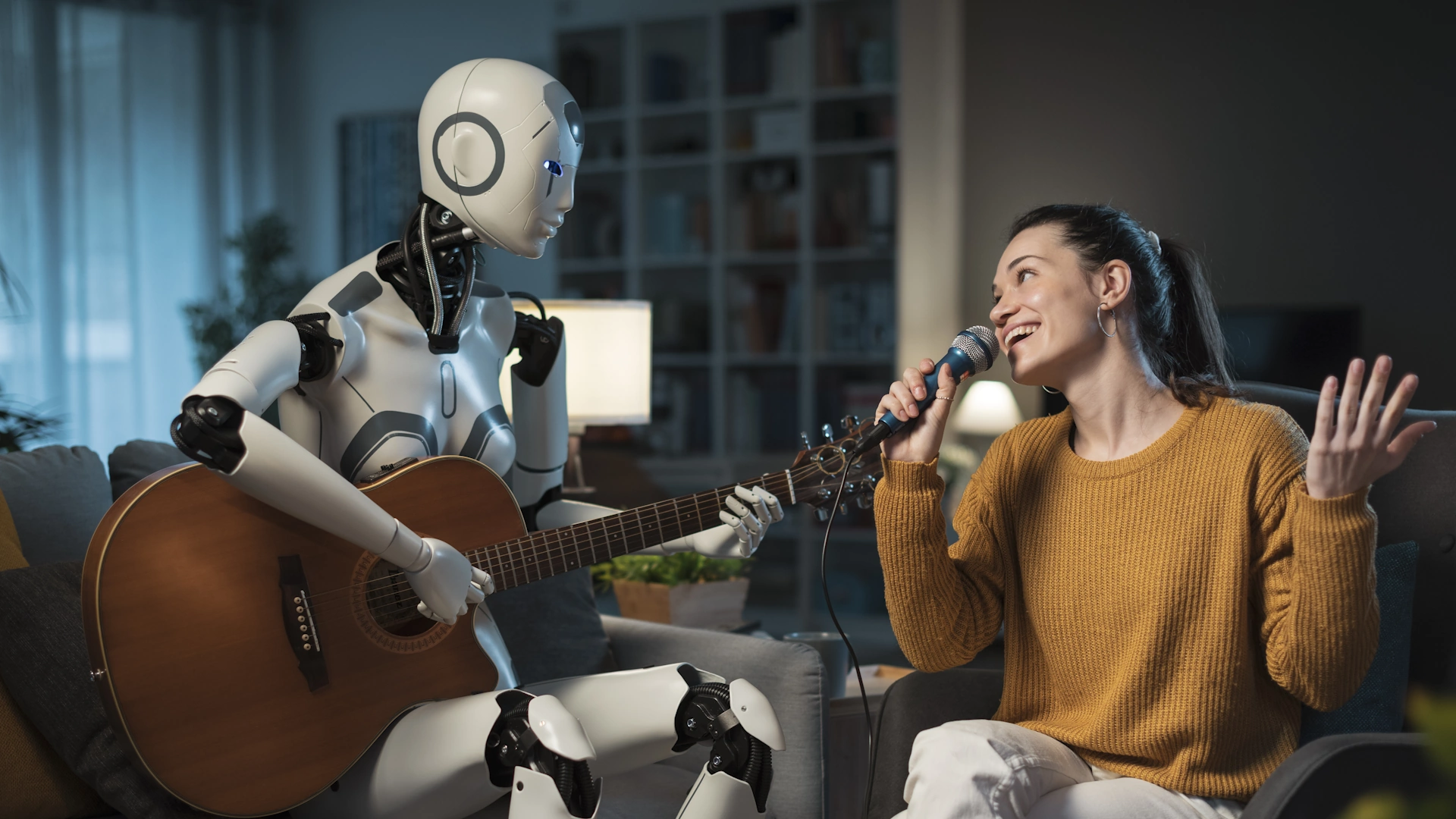
You may have noticed that I recently added a “NO AI” banner to all the songs I produce for UTB Songs. I thought it would be a good idea to write a post explaining my reasoning behind this. After all, you might think that the songs I make would be an ideal fit for AI: I’m not the best producer and musician in the world, and I am certainly not the best singer! I could probably achieve more ‘professional’ results by using AI. So, why not simply use AI? Why be a stick-in-the-mud?
What I’d like to do here is explain, as concisely as possible, my reasons for avoiding AI.
AI doesn’t know God
If you go to ChatGPT or the like, you can prompt it to write the lyrics of a Christian song and it will happily go away and do just that. The thing is, if you know anything about these large language models (LLMs), you know that they are not really generating anything new: they are simply rehashing things which already exist.
So, if you feed in to an LLM all the hymns and Christians songs which have been written through the centuries, it could take a pretty good stab at coming up with something that sounds like them. BUT – you know that it hasn’t really thought about the Bible, prayed about it, and listened to the voice of the Holy Spirit.
I believe our motivation for writing songs — all songs, but especially Christian songs — should be because we have something to communicate and express through music. Think of David’s opening words from Psalm 36: “I have a message from God in my heart concerning the sinfulness of the wicked…” David had a message from God which prompted him to create this Psalm.
AI is the complete opposite of that: AI doesn’t have a message from God in its heart, because it doesn’t know God. It can’t pray, it can’t read the Bible, it can’t know God. It’s essentially a machine, it’s an impersonal algorithm. All it can do is produce a kind of rehash of what other people in the past have said.
This is why I believe it is utterly inappropriate to use AI to generate Christian song lyrics, and this is why I refuse to use AI in songwriting. All songs I wrote for Songs with UTB have been written in the traditional way, without the use of AI.
But that’s only the first step of the process. what about the recording part of creating a song? Wouldn’t it be better for me to use AI to generate the vocals and instruments, and mix them, rather than doing it myself?
AI is offensive to human creativity
Before I get started on this, let me say that I have tested out creating songs with AI. I used Suno to create a couple of songs, and technically they sounded very professional and probably ‘better’ than anything I could make at home. BUT…
If you’ve ever had any experience of producing songs, you’ll know that the whole creative process of arranging and recording a song involves hundreds if not thousands of decisions which will all have an impact on the final result. For example:
- There is no such thing as ‘some acoustic guitar’. Every guitar will sound different, before you get to how and where they are recorded.
- Similarly, there is no such thing as ‘some piano’. If you’re recording a real piano, that will obviously have its own personality before you even get to the differences in recording it. If you’re using a piano library via MIDI, again, there are hundreds available.
- You could repeat this for every instrument. For example, I have a few synthesizer libraries which I like and can afford. Same with drums, bass, strings, etc.
The upshot of this is that every decision I make is a mixture of the options available to me, the limitations I have, and my creative vision for the particular song.
Sometimes I make a decision which takes the song in an unexpected direction which I’d never have thought of in advance. Sometimes I’ve just got hold of a new virtual instrument and I’m keen to make use of it. All these things contribute to the song which eventually comes out.
I can tell you that the songs I have produced for UTB Songs are so full of me — not in an egotistical way, but simply to say that when you listen to a song I’ve produced, it is coming from me to you. When you listen to a UTB Song, you are listening to me — for better or worse. It’s not perfect, I freely acknowledge that, but it is at least me. It seems to me that this is a good and healthy attitude which artists take towards their work: they create work not to make money but to express themselves, to express something of what it means to be human from their perspective. When you listen to a song or look at a piece of art from a human, you are in a sense entering into their world. This could never be the case with AI.
When I tried generating songs with Suno, it didn’t feel at all personal: it was like listening to songs which had been written and performed by someone else. With songs I’ve produced, I do feel a real connection with them because I remember the effort which went into each one. Suno, on the other hand, makes it easy — and thus makes it pointless.
At the end of the day, all AI can do is take a guess at what would sound good based on what others have done that sounded good. It will never really produce anything original, it will always be derivative. And it certainly cannot produce anything which sounds like you or me!
What is ‘better’?
One of the reasons people have turned to AI is because it can create ‘professional’ sounding results easily. But is that the only thing which really matters?
Think about it like this. A few weeks ago we went to see the Turner & Constable exhibition at Tate Britain. Among the exhibits were some of Turner and Constable’s sketches – e.g. notebooks where they would quickly sketch out some ideas before going on to create a full-size painting. Consider: what would be worth more: one of their sketches, or a picture created by AI? Although the picture created by AI might be ‘better’ in terms of its quality, it wouldn’t be worth anything compared to the artist sketches.
Why is that? Perhaps because AI is cheap – anybody can use it. By contrast, Turner & Constable cannot be replicated.
I think it’s a bit like that with music: I’d much rather listen to a piece of music which somebody has taken the trouble to compose and produce, even if it has flaws, than a piece of music which was generated by AI. In fact I’ve come to appreciate flaws much more than I used to, simply because it’s a signal that what I’m listening to has been produced by real humans and not an algorithm!
Personally I value somebody taking time and effort to create a piece of art for others to enjoy. I would rate that higher than AI generated content in pretty much any circumstance.
This is also not to mention the fact that people can improve over time. I hope that I have become a better producer and musician over the last couple of years that I’ve been producing songs. I go back and listen to some of the songs I did when I first started and think that they sound primitive. But then, that’s part of the whole human experience, isn’t it: we grow! AI can’t grow, it simply is.
People are fed up with AI slop
AI has become so ubiquitous on social media now that there’s a word for it — ‘slop’. For example, whenever I watch a video on YouTube, I can guarantee that there will be at least one AI-Generated video that YouTube suggests to me. There are plenty of AI Generated Christian songs, and I think they’ve even started to get into the ‘inspirational Christian message’ category.
The problem with AI Slop is that it’s so… boring. It’s lifeless and dull. I’m sure I’m not the only one to think this — as I was searching for the link for AI Slop, the first autocomplete suggestion was ‘ai slop is boring’! A lot of people are fed up with AI generated songs and content.
The simple fact of the matter is, I’d rather listen to something a human being took the trouble to do over several hours or days than listen to something that was generated by an algorithm in a few seconds. Every single time.
Conclusion
As I close, let me clear one thing up: I don’t want this to be read as me being “anti-AI” or “anti-technology” in any circumstance. I think AI and technology has its place — they can be hugely powerful tools. But that’s what they are, tools. Tools should help us create, but they are not there to create in themselves. And that is the problem with AI. It’s a powerful tool but we have to learn to use it wisely — or, perhaps, when not to use it.
When it comes to songs with UTB, I’m happy to say that I will continue to write and produce songs in the traditional way, without the use of AI. If it means I put out songs which have flaws and aren’t perfect – well, welcome to being human. And let’s rejoice and enjoy being the creators that God made us to be.

Leave a Reply