Being an influencer for Jesus – Matt 5:13-16 – 7th May 23

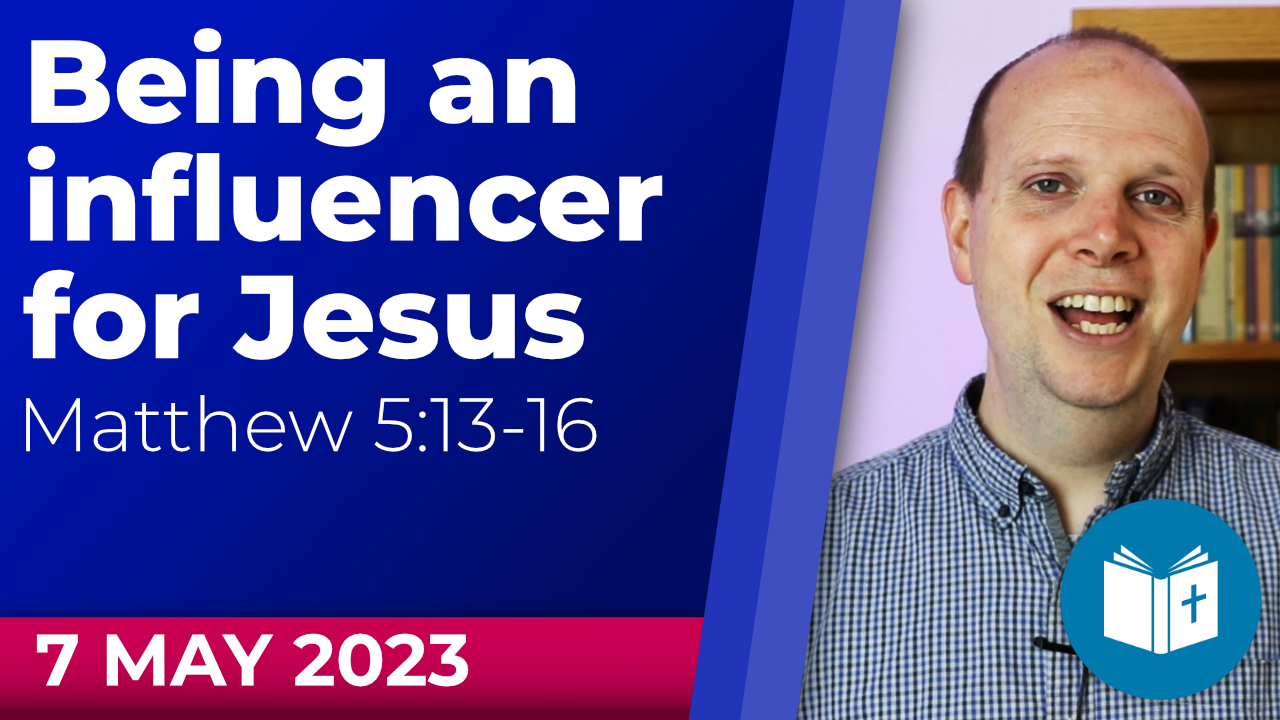
It’s the second week of Church with UTB and we are continuing with the Sermon on the Mount. Please do have a look at that page if you need an explanation of how to make use of Church with UTB. I am working on some more resources, including a printable order of service and an online tool to generate your own, so hold tight. They will be available soon!

Sermon – Being an influencer for Jesus (Matthew 5:13-16)

Suggested Songs

Bible readings

  • Matthew 5:13-16 (sermon – the video includes the passage being read)
  • Psalm 103 (if too long just read the first half – verses 1-12)

Catechism

The catechism videos are undated, as it’s best to work your way through in sequence. Simply pick the next one from this playlist.

For more information about making use of this, see the Church with UTB page.

Share this:

What the Christian life is all about – Church with UTB 30-04-23

For the first proper week of Church with UTB, we’re going to be starting a new series on the Sermon on the Mount. Please do have a look at that page if you need an explanation of how to make use of Church with UTB – but I will be producing more resources soon.

Sermon – “What the Christian Life is all about” (Matthew 5:1-12)

Suggested songs

Bible readings

  • Matthew 5:1-12 for the sermon (the video starts with the reading so you don’t need to have it read first)
  • Psalm 98

Catechism

The catechism videos are undated, as it’s best to work your way through in sequence. Simply pick the next one from this playlist.

For more information about making use of this, see the Church with UTB page.

Share this:

Doubting Thomas: choosing faith over doubt

I’m sure you are familiar with the phrase “seeing is believing”. We often say that we need to see something with our own eyes before we can believe it.

That’s the subject of our Bible reading for the first week after Easter. It’s from John 20, the famous story of doubting Thomas. On the eve of that first Easter Day, Jesus appeared to his disciples while they were together – but Thomas was not present. When the other disciples told him what had happened, he said: “Unless I see the nail marks in his hands and put my finger where the nails were, and put my hand into his side, I will not believe.”

Thomas refused to believe the testimony of his friends, those he knew to be trustworthy and reliable. Instead, he chose to say that he would not believe unless he had seen Jesus with his own eyes.

Perhaps this is an attitude that we can sympathise with: as human beings we can find it hard to believe without the evidence of our own eyes. “Seeing is believing”, we say, and if we don’t see we don’t believe. Even if not believing means we have to distrust people we know well. Perhaps there is something of the “doubting Thomas” in each one of us.

So, how did things work out for our friend Thomas? Let’s look at what happens next in the story:

26 A week later his disciples were in the house again, and Thomas was with them. Though the doors were locked, Jesus came and stood among them and said, “Peace be with you!” 27 Then he said to Thomas, “Put your finger here; see my hands. Reach out your hand and put it into my side. Stop doubting and believe.”

28 Thomas said to him, “My Lord and my God!”

29 Then Jesus told him, “Because you have seen me, you have believed; blessed are those who have not seen and yet have believed.”

Jesus did not commend Thomas for his doubts. Thomas should have believed the other disciples, his closest friends. He should have listened to what Jesus had taught them before about how he was to be killed and then raised on the third day. Instead, Thomas made the conscious choice not to believe. I think this reflects a battle that we all face day by day.

We all face the choice every day to respond to our circumstances with faith or with doubt. We can choose which eyes to see with – eyes of faith, or eyes of doubt. We can choose to see the risen Lord Jesus at work in our lives and trust in his promises, or we can choose to deny him.

Jesus finishes by saying, “Blessed are those who have not seen and yet have believed.” It is a blessing to trust in the Lord, even though we do not see him. By faith we trust that our sins are forgiven. By faith we trust that he is able to care for us and provide for us. By faith we trust that he is able to direct our lives in the way that is best. By faith we believe that he is willing and able to answer prayer.

We cannot see the Lord Jesus with our eyes, yet with eyes of faith we believe and trust that he is there. And as we trust in him day by day, as we choose to see with eyes of faith, we come to experience that he is faithful, and that he is able to keep his promises to us.

I will leave the last word to the apostle Paul, from 2 Corinthians 4:

Therefore we do not lose heart. Though outwardly we are wasting away, yet inwardly we are being renewed day by day. 17 For our light and momentary troubles are achieving for us an eternal glory that far outweighs them all. 18 So we fix our eyes not on what is seen, but on what is unseen, since what is seen is temporary, but what is unseen is eternal.

This was originally written as a ‘Thought for the Week’ for a local publication.

Share this:

“Which crisis are you celebrating this year?” – Christmas Message 22 – Romans 8:31-39

An honest Christmas message: given all the crises we seem to be dealing with, is there any real hope at the moment? We look at Romans 8:31-39 to see that Jesus gives us hope especially in times of hardship.

Looking for more?

Last year’s Christmas message is still available to watch, Can you find Christmas lights bright enough for 2021?

All Christmas content on Understand the Bible is under the Christmas category. You might also enjoy the advent series about the day of the Lord.

Share this:

Are you ready for the day of Christ? – Zechariah 14:1-21 Sermon

The third part of our Advent series on ‘The Day of the Lord’, looking at a picture of the end – the day of Christ. What will that be like, and are we ready for it?

Enjoyed this sermon? See more on the sermons page.

Sermons are also available on the podcast.

Share this:

Christmas reveals who we trust in – Isaiah 2:6-22 Sermon

The second part of our Advent series on ‘The Day of the Lord’. When God draws near, it reveals who or what we are really trusting in.

Enjoyed this sermon? See more on the sermons page.

Sermons are also available on the podcast.

Share this:

Why do you want Christmas? – Amos 5:18-27 Sermon

This sermon is the first part of an Advent series looking at the “Day of the Lord” in the Bible. In this first part, from Amos, we think about why people want to come to church at Christmas and what Amos says about what’s really important.

Enjoyed this sermon? See more on the sermons page.

Sermons are also available on the podcast.

Share this:

How to do the right thing even under pressure

One of the problems we face in life is having the strength to do the right thing, even if we are under pressure to do the wrong thing. We often find it difficult to do the right thing when we are not under pressure – but it’s even harder when the pressure is increased.

We can face pressure from many different quarters: we usually talk about peer pressure in relation to children and teenagers, but adults are equally vulnerable to it. If all our friends are going along with something, it can be very difficult to stand out from the crowd.

We can face pressure from work, for example if a superior asks us to cover something up by lying. This is even more difficult to face up to – how many people would be strong enough to resist the pressure, even if it meant losing their job?

In our church children’s holiday club this year, we looked at the story of Daniel. Daniel is a book which many people will be familiar with from Sunday school: the stories are vivid and engaging! And yet they also teach us some very important lessons.

One of the stories centres on Daniel’s three friends – Shadrach, Meshach, and Abednego. King Nebuchadnezzar had set up a 90-foot high golden image, and commanded everyone to bow down and worship the image. He also threatened that anyone who did not bow down and worship would be thrown into a fiery furnace.

Daniel’s three friends knew that this was wrong – they knew that it went against the Ten Commandments: God said that we should worship him alone, and not bow down to an idol.

How do you think you would have responded in this situation? Do you think you would have had the strength to resist the might of an angry king and the punishment of the fiery furnace? I imagine that most of us would have caved in and bowed down. What could possibly give anyone the strength to stand up for what was right in such circumstances?

Let’s look Daniel 3:16-18 to see how the friends answered the king:

Shadrach, Meshach and Abednego replied to him, “King Nebuchadnezzar, we do not need to defend ourselves before you in this matter. 17 If we are thrown into the blazing furnace, the God we serve is able to deliver us from it, and he will deliver us from Your Majesty’s hand. 18 But even if he does not, we want you to know, Your Majesty, that we will not serve your gods or worship the image of gold you have set up.”

The three friends firstly say to the king ‘we do not need to defend ourselves before you’. What the king had asked them to do what manifestly wrong, and they did not need to justify their refusal to do it.

They then say that God is able to deliver them from the furnace. They know that the God they serve, the God who gave the commandments in the first place, is powerful and able to save. They know that there is a higher authority than the king.

But note that they do not presume that God will save: they say “even if he does not” – even if they may perish in the furnace, they will not bow down. They commit themselves to doing what is right, whatever the cost, trusting that God will see and honour their obedience.

I think the lesson of these three friends is an important one for us to learn. Shadrach, Meshach, and Abednego knew that there was a higher authority than any earthly king. They knew that they could not go against the will of the God who made everything. They had faith that God would reward them for doing what was right, and they entrusted themselves to him.

This helps us today when we are facing pressure to do the wrong thing: we should remember that we are almost certainly not facing pressure like Daniel’s friends faced! We should remember that it is more important to do what is right according to the God who made the universe. We should trust that God sees and rewards our trust in him. And we should commit ourselves to pleasing him and doing what is right and good.

In this way, we can have strength – like Daniel’s friends – to stand up for what is good and right, however much pressure we face.

This was originally written in July 2022 as a ‘Thought for the Week’ for a local audio newspaper.

Share this: