Keeping the Rules (Murder) – Matthew 5:17-26

Is Christianity only about keeping the rules? Is it all about obeying the Ten Commandments? In this session Jesus starts to explain why God gave us the Law and what kind of obedience he wants from us. Jesus takes us through an example “Do not murder” and helps us to understand.

The previous Sermon on the Mount video on “Engaging with the World: Salt and Light” is available here.

In due course this series will replace the existing Sermon on the Mount series.

Share this:

Engaging with the world: Salt and Light – Matthew 5:13-16

Jesus taught that following him was not simply a private affair but had implications for how we engage with the world. In this session we explore two images he used to explain – “salt” and “light”.

The previous Sermon on the Mount video on the Beatitudes “The Blessed Life” is available here.

In due course this series will replace the existing Sermon on the Mount series.
Share this:

“The Blessed Life” – Beatitudes – Matthew 5:1-12

What does it mean to be blessed by God? What does the Christian life look like? In this first part of the Sermon on the Mount, we look at Jesus’ manifesto for the Christian life.

What happened to the old Sermon on the Mount series?

Those of you who are paying attention may have noticed I already have a series on the Sermon on the Mount. What has happened to that one? Well, that series was originally recorded back in 2018. It was one of the first series I recorded – well before it was called Understand the Bible! Those videos look dated and are well due for an update. I’ve decided to record fresh videos, and I will be uploading those over the coming weeks. When it is completed, I will replace the existing Sermon on the Mount course here on the website with the new videos.

Share this:

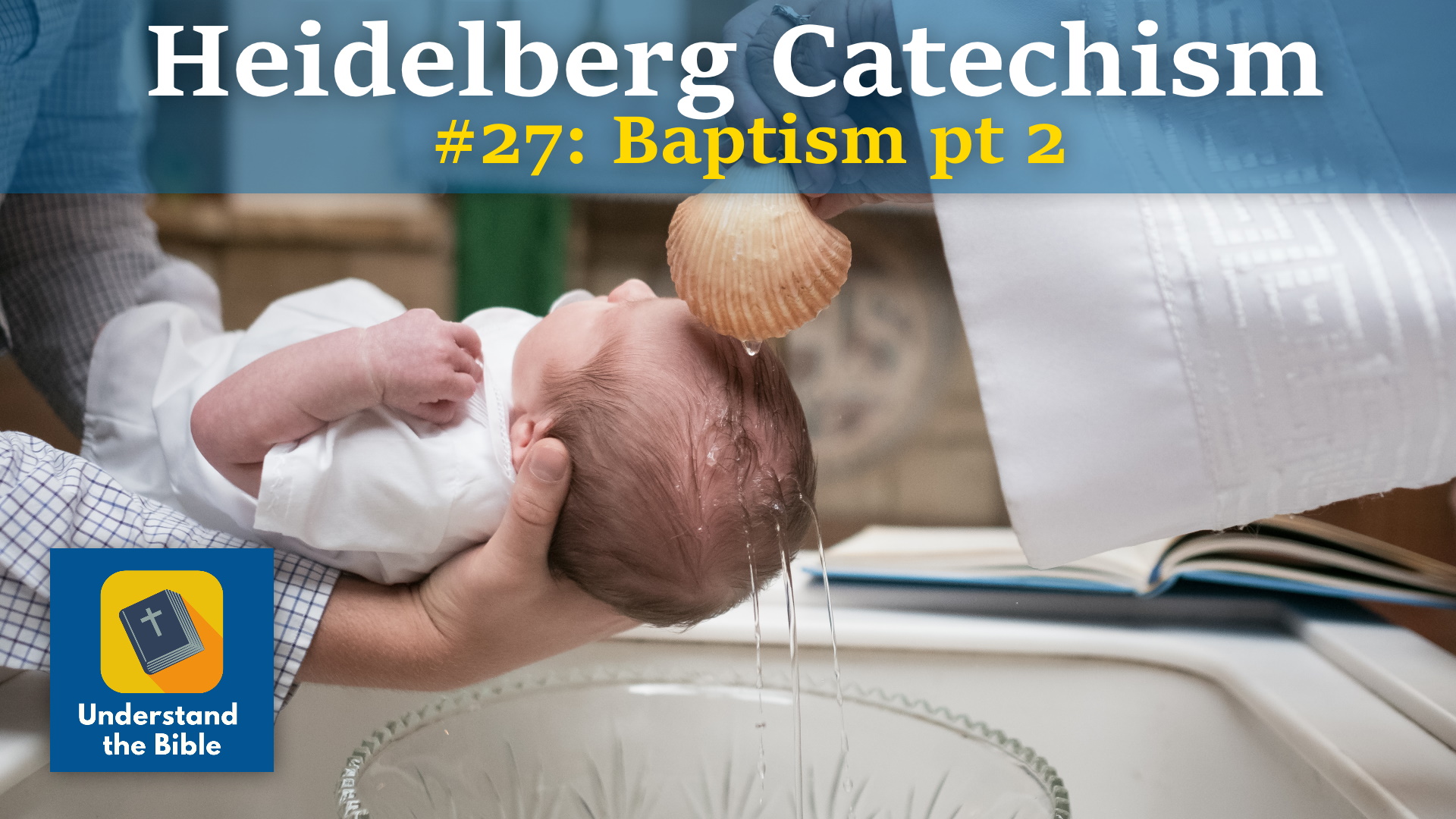
Baptism pt 2 – baptising infants (Heidelberg 27)

We continue thinking about baptism in this session (following on from the previous session) and there are two important questions: (1) does baptism just work in and of itself, and (2) should we baptise infants?

The question of baptising infants is something which churches do not agree on today. At the time of the Reformation (when the Heidelberg Catechism was written), it was the practice of Reformed churches such as the Church of England to retain this practice. In this session we’ll take a brief overview of why the Reformers believed this was right. I do not wish to be divisive! But it can be helpful to look at other perspectives and remember that Christians may disagree on certain things without it being an issue of critical importance.

There are three questions in this session:

  • Q72: Does this outward washing with water itself wash away sin?
  • Q73: Why then does the Holy Spirit call baptism the washing of regeneration and the washing away of sin?
  • Q74: Should infants, too, be baptised?

Want more?

If you enjoy this, you can do the whole series right here on the website, or on the app (see links on the right hand side of the page). Alternatively, I am uploading them regularly to YouTube and Facebook. All sessions on YouTube are available on this playlist.

Share this:

What is baptism? (Heidelberg 26)

In this session we start looking at baptism – what baptism represents and how it links in with the gospel. Baptism is one of the sacraments, which we started looking at last time. In that session we started to think about how the sacraments have been given to help us understand the gospel. This is exactly what baptism is about.

There are three questions in this session:

  • Q69: How does baptism signify and seal to you that the one sacrifice of Christ on the cross benefits you?
  • Q70: What does it mean to be washed with Christ’s blood and Spirit?
  • Q71: Where has Christ promised that he will wash us with his blood and Spirit as surely as we are washed with the water of baptism?

This last question gets to the heart of a sacrament: it reminds us that the spiritual cleansing from sin offered in Christ is as real as taking a bath or shower! Jesus cleanses us truly on the inside, as surely as water cleanses us on the outside.

Want more?

If you enjoy this, you can do the whole series right here on the website, or on the app (see links on the right hand side of the page). Alternatively, I am uploading them regularly to YouTube and Facebook. All sessions on YouTube are available on this playlist.

Share this:

What are Sacraments? (Heidelberg 25)

What are the sacraments and why are they important for Christians? In this session we start to look at the sacraments and how God uses them to help us to understand the gospel.

There are four questions in this session:

  • Q65 – Since faith alone makes us share in Christ and all his benefits, where does this faith come from? (In other words, is even faith itself something which is to our own credit?)
  • Q66 – What are the sacraments?
  • Q67 – Are both the Word and the sacraments then intended to focus our faith on the sacrifice of Jesus Christ on the cross as the only ground of our salvation?
  • Q68 – How many sacraments has Christ instituted in the new covenant?

This last question is one where particularly Roman Catholics and protestants will disagree. Protestant churches believe there are only two sacraments. It’s no surprise that the Heidelberg Catechism, being a Reformed / protestant catechism, takes this line.

The sacraments were one of the key battle grounds in the middle ages between Catholic and protestant theology, and it’s important to understand what they are and why they’re important. I hope that the Heidelberg Catechism in looking at the sacraments warms your heart and enlivens your faith as you think through these things.

Want more?

If you enjoy this, you can do the whole series right here on the website, or on the app (see links on the right hand side of the page). Alternatively, I am uploading them regularly to YouTube and Facebook. All sessions on YouTube are available on this playlist.

Share this:

Why are good deeds not enough? (Heidelberg 24)

Having heard that we are made right with God through faith alone, in this session we think about two questions people often ask: why can we not please God through good works? And if our good works don’t earn anything – doesn’t that mean we can just do what we like?

This is such an important issue to be thinking about. If good works don’t earn anything with God, does that just mean we can act however we like? It’s a good question, and it’s one which a lot of people ask.

The Heidelberg breaks it down into three questions:

  • Q62 “Why can our good works not be our righteousness before God, or at least a part of it?”
  • Q63 “But do our good works earn nothing, even though God promises to reward them in this life and the next?”
  • Q64 “Does this teaching not make people careless and wicked?”

I think that final question is the one which people ask – if our good works don’t earn anything, why not just do whatever you like? Why not just live any way you choose? What does the Bible have to say to that question…

Want more?

If you enjoy this, you can do the whole series right here on the website, or on the app (see links on the right hand side of the page). Alternatively, I am uploading them regularly to YouTube and Facebook. All sessions on YouTube are available on this playlist.

Share this:

Faith Alone (Heidelberg 23)

In this session we are looking at one of the most fundamental doctrines of the Christian faith – that we are right with God (or “justified”) by faith alone. Not through the good works that we do or by earning in any way.

This is really taking the things we’ve looked at over the past few weeks (the Apostle’s Creed) and asking, “Why is it important to believe all of this? And how do we benefit from it?”

There are three questions in this Lord’s Day:

  • Q59 “But what does it help you now that you believe all this?”
  • Q60 “How are you righteous before God?”
  • Q61 “Why do you say that you are righteous only by faith?”

“Faith alone” is one of the most important topics that Christians can think about – it makes a huge difference to the Christian life. It’s hard to overstate how important it is.

Want more?

If you enjoy this, you can do the whole series right here on the website, or on the app (see links on the right hand side of the page). Alternatively, I am uploading them regularly to YouTube and Facebook. All sessions on YouTube are available on this playlist.

Share this:

Eternal Life (Heidelberg 22)

In this session we finish off looking at the Apostle’s Creed: what does eternal life look like, and what comfort should we take from it?

There are two questions in this session. They’re based on the final lines of the Apostles’ Creed, “I believe in the resurrection of the body, and the life everlasting”.

  • Q57 “What comfort does the resurrection of the body offer you?”
  • Q58 “What comfort do you receive from the article about the life everlasting?”

A lot of people have questions about what eternal life / heaven looks like. The Bible doesn’t tell us everything we want to know – yet at the same time, there are things we can know. And it’s not about floating around in the clouds with a harp!

Want more?

If you enjoy this, you can do the whole series right here on the website, or on the app (see links on the right hand side of the page). Alternatively, I am uploading them regularly to YouTube and Facebook. All sessions on YouTube are available on this playlist.

Share this:

The Church and Forgiveness (Heidelberg 21)

In this session we take a closer look at the church – what is the church, and what does it mean for us to be part of it? We also think about forgiveness of sins and how struggling can be a good sign in the Christian life…

There are three questions in this session, focussing on the lines in the Apostles’ creed: “I believe in the Holy Catholic church, the communion of saints, the forgiveness of sins”. These are the main things we look at:

  • Firstly – a note about the “Catholic” church. This just means ‘universal’ rather than the Roman Catholic church.
  • Q54: What do you believe concerning the holy catholic church? – what the church is, and what it means for us to be a member of it.
  • Q55: What do understand by the communion of saints? – how do we relate as Christians to other members of the church?
  • Q56: What do you believe concerning forgiveness of sins? – it feels a bit tacked on at the end but it’s fundamental! What is forgiveness in the Christian life, in summary?

If you enjoy this, you can do the whole series right here on the website, or on the app (see links on the right hand side of the page). Alternatively, I am uploading them regularly to YouTube and Facebook. All sessions on YouTube are available on this playlist.

Share this: