How to deal with injustice: Psalm 10

In Psalm 9 we started thinking about injustice in general. This Psalm focuses down more on justice done by specific individuals. How should we respond?

This is part of the weekly Thought for the Week series. This series is designed to give a short, 10-minute ‘thought’, including a Bible reading and a prayer. At the moment I am working my way through the Psalms but I may take a break from them after a while and look at another part of the Bible.

Do subscribe to the mailing list if you want to get these delivered by email, or subscribe directly on YouTube if you want to see them there.

You can see the previous week’s thought on Psalm 9 “God the Ultimate Justice Warrior” here.

Share this:

Do Christians need to keep the 10 Commandments?

One of the biggest questions people have about the Christian life is about our obedience. Do Christians need to keep the 10 Commandments? Is that what the Christian life is all about?

This is another huge topic, so this video is just a short introduction with a couple of pointers to some more detailed information.

Summary of the video

Here’s a brief summary of the points I make in the video:

  • Do Christians need to keep the 10 commandments? The answer is “It’s complicated” – it’s a bit like yes / no / yes…
  • In Matthew 5:17, Jesus said: “Do not think that I have come to abolish the Law or the Prophets; I have not come to abolish them but to fulfil them.”
  • Jesus didn’t come to remove any laws but fulfil them. What does that mean?
  • Romans 3:20 says, “through the law we become conscious of our sin”.
  • The Law shines a light on our lives and helps us to see our sin.
  • The reason we need the law in the first place is because there is something wrong with us – we want to do the wrong thing.
  • Romans 8:1-4 says that the law cannot help us with our innate problem with sin – only Jesus can do that.
  • Jesus came to do what the law couldn’t do. He makes us righteous from the inside out.
  • Jesus can help us want to love God and love others – something which we could never do by simply trying to obey the commandments.
  • Jeremiah 31:33 says, “I will put my law in their minds and write it on their hearts.” This is a prophecy of what God would do in Jesus.
  • Through Jesus, through the Holy Spirit, God writes his laws on our hearts.
  • Finally, in Matthew 5:21-22 Jesus uses the example of murder. It’s a command most people think they’ve kept. But Jesus shows that none of us have kept even this law perfectly.
  • We need a transformation to love others!

Explore further

You might like to look at the Sermon on the Mount course.

You might also appreciate session 15 of the New City Catechism: What’s the point of the Law (if we can’t keep it)?

Your questions answered

This is the third video for the Your questions answered feature.

If you have a question about Christianity or the Bible, please send them in or comment below.

Share this:

Mark 2:13-17 – Learn to read the Bible #7

I’ve just published the sixth part of the Learn to read the Bible series on Mark’s Gospel. This week we are looking at Mark 2:13-17, when Jesus calls the tax collector Levi.

For those who are coming to this new, the idea behind this series is not for me to simply explain everything to you, but rather to give you things to think about yourself. This is about training you to read the Bible for yourself, rather than just giving you all the answers!

See this page if you’d like a few pointers for how to use these videos.

You can read the passage online here (although I’d suggest it’s better in a physical Bible). You may also want to have a pen and paper handy to jot down notes and things you want to look into more.

Key points from Mark 2:13-17

One important thing for understanding this passage is to realise how people saw Tax Collectors. You might find it helpful to look up a page with some background info about tax collectors.

There were three points I made in the video for you to think about:

  1. Jesus called Levi – a tax collector – who would have been despised by the Jewish authorities at that time. Can you think of anyone today who might be despised in a similar way? What does that teach us about who God calls and values?
  2. The Teachers of the Law questioned why Jesus ate with “tax collectors and sinners”. What do you think that says about how they saw themselves? Do you think they didn’t see themselves as sinners? Were they right to see themselves this way?
  3. Jesus said he didn’t come to call the righteous, but sinners. Think about our relationship to God. What does that mean about how we should relate to God? How can we come with honesty and integrity to God?

Looking for more?

You can see the rest of the videos in this series on the this page. If you’d like a more focussed series teaching the Christian faith, check out the teaching programme.

You might also want to see the previous episode in the series on Mark 2:1-12.

Share this:

God the Ultimate Justice Warrior: Psalm 9

Social Justice has gone mainstream in 2020 with the BLM movement. This Psalm is all about justice: what does God have to say about it?

This is part of the weekly Thought for the Week series. This series is designed to give a short, 10-minute ‘thought’, including a Bible reading and a prayer. At the moment I am working my way through the Psalms but I may take a break from them after a while and look at another part of the Bible.

Do subscribe to the mailing list if you want to get these delivered by email, or subscribe directly on YouTube if you want to see them there.

You can see the previous week’s thought on Psalm 8 “You are not insignificant” here.

Share this:

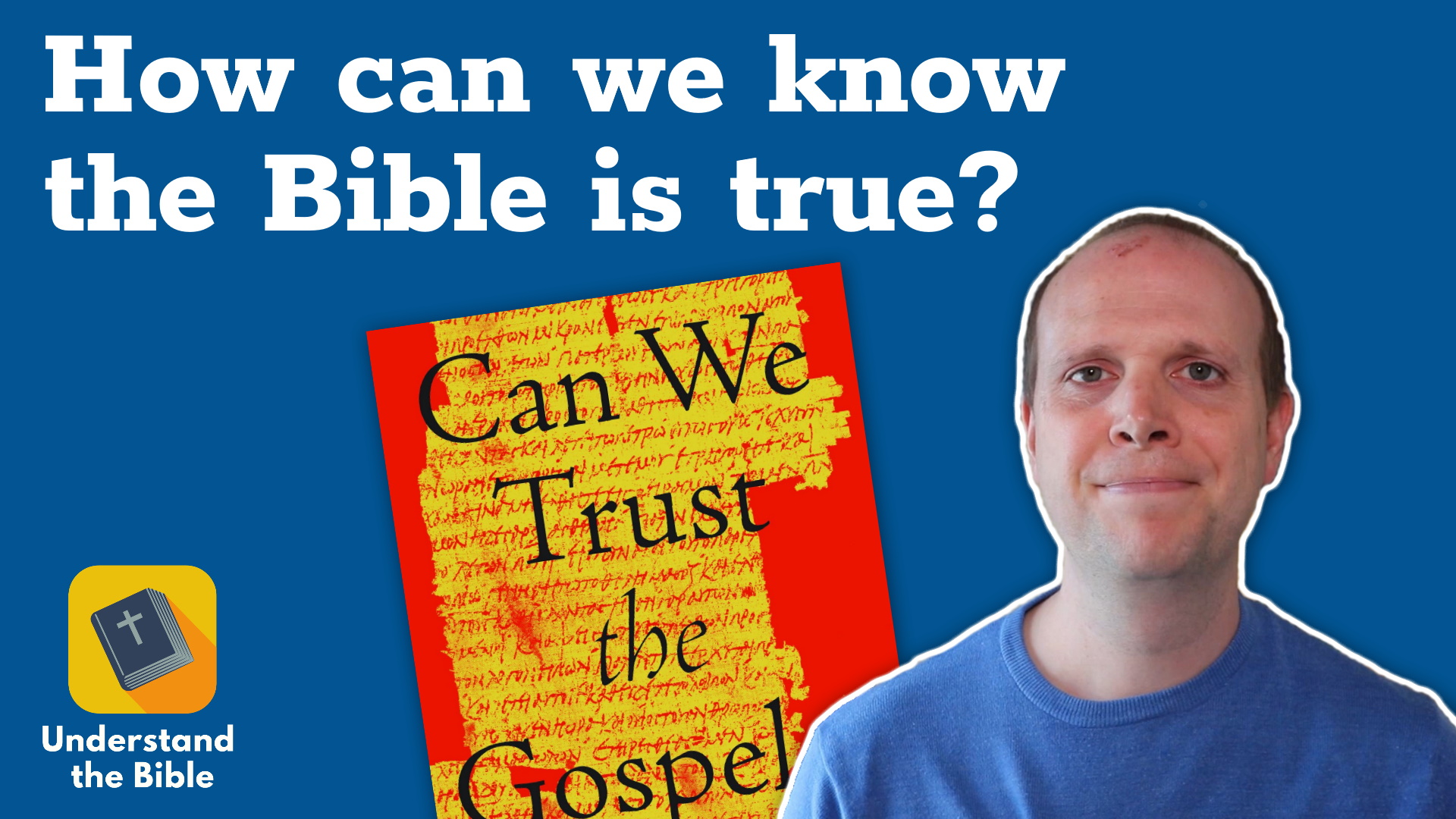
How can we know the Bible is true?

One of the questions people often have is, how can we know the Bible is true? The Bible contains so much which seems strange to us. For one, it’s full of miracles. And the very centre of the story is based on Jesus – a man who performed many miracles and rose up from the grave. Can we trust that this is true, or is it more like one of Aesop’s fables?

This is a huge question and obviously in a short video we don’t have time to look at all the answers. In this video I focus on the gospels, drawing on Peter Williams’ brilliant book Can we Trust the Gospels?

Summary of the video

  • The Bible centres on the life, death, and resurrection of Jesus – so if we can trust the gospels, we can almost certainly trust the rest of the Bible.
  • Peter Williams’ book is the best book on the reliability of the gospels that I’ve ever read.
  • He talks about a number of reasons why we can trust in the gospel as historically reliable. Here are just a couple:
    1. Geography. The gospels talk about a lot of places. All four gospels have unique place names which no other gospel mentions. Those place names range from large, common cities to local, relatively uncommon names. For someone to make this up, it would require research beyond anything we’ve ever seen from this time period!
    2. Undesigned coincidences. This is when a fact in one gospel is confirmed almost “accidentally” by another gospel. So, for example, Mark describes James and John as the ‘sons of thunder’. Luke doesn’t call them that, but he does record them wanting to call down fire on a village.
  • He says that if it wasn’t for the miracles of Jesus, no serious historian would consider the gospels unreliable. So can we trust that the miracles are true?
    1. The miracles are not random – they occur within a whole picture which fits together. It would take a huge leap of faith to believe everything was fiction or happened by coincidence.
    2. The resurrection turns the disciples around. Through the gospels, the disciples are portrayed as misunderstanding lots of things, rarely getting anything right. What turned them into the group of men who evangelised the world? They would not have suffered and died as they did unless they knew it was true.
    3. The first witness of the resurrection was a woman. In those days, the testimony of a woman was inadmissible in court. No-one wanting to make up the story of the resurrection would make a woman be the first witness of the resurrection. It wouldn’t help the case at all.
  • As Sherlock Holmes famously said: “When you have eliminated the impossible, whatever remains, however improbable, must be the truth”. It would take more faith to believe that the gospels were not true.

Your questions answered

This is the second video of a new feature called Your questions answered. (This particular video was originally recorded for my own church).

If you have a question about Christianity or the Bible, please send them in or comment below.

Share this:

Mark 2:1-12 – Learn to read the Bible #6

I’ve just published the sixth part of the Learn to read the Bible series on Mark’s Gospel. This week we are looking at Mark 2:1-12, when Jesus forgives and heals a paralysed man.

For those who are coming to this new, the idea behind this series is not for me to simply explain everything to you, but rather to give you things to think about yourself. This is about training you to read the Bible for yourself, rather than just giving you all the answers!

See this page if you’d like a few pointers for how to use these videos.

You can read the passage online here (although I’d suggest it’s better in a physical Bible). You may also want to have a pen and paper handy to jot down notes and things you want to look into more.

Key points from Mark 2:1-12

This is a really important passage in Mark’s Gospel and it’s worthwhile spending a bit of time thinking and praying about!

  • Mark once again draws attention to Jesus’ fame spreading. Think about YouTube stars or people who draw a large following online – what must it have been like in Jesus’ day?
  • The paralysed man’s friends broke through the roof and lowered him to Jesus. What does this show about them? What obstacles are there which might stop us from getting to Jesus, and what should we do about it?
  • Why does Jesus say ‘your sins are forgiven’ when the man needed physical healing? What does that say about Jesus’ priorities?
  • Are the teachers of the Law right when they say only God can forgive sins? Was Jesus blaspheming? What does that say about who Jesus is?
  • Jesus says “I want you to know that the Son of Man has authority on earth to forgive sins”. Does this help us to understand Jesus’ other miracles?

Looking for more?

You can see the rest of the videos in this series on the this page. If you’d like a more focussed series teaching the Christian faith, check out the teaching programme.

You might also want to see the previous episode in the series on Mark 1:35-45.

Share this:

Raising Children: Final part of How to Live as a Christian course

The final part of the course looks at how we should raise children. Passing the faith on to the next generation is key – how do we do it?

In this session we cover:

  • What the Bible says about children and families;
  • Some practical ways that parents can pass their faith on to children;
  • Some practical ways that the church can help;
  • Resources to help you.

This brings to a close the How to Live as a Christian course, which is now available to complete on the website or the app.

The How to Live as a Christian series is designed to help new (and not-so-new) Christians get up to speed about living in the way God wants us to. It’s designed to be practical, so that it’s not just all about the theory. You can now do the course on the website here.

Share this:

You are not insignificant – Psalm 8

If you look up at the night sky, it can seem like we are tiny and insignificant. But that’s not how David sees it.

This is part of the weekly Thought for the Week series. This series is designed to give a short, 10-minute ‘thought’, including a Bible reading and a prayer. At the moment I am working my way through the Psalms but I may take a break from them after a while and look at another part of the Bible.

Do subscribe to the mailing list if you want to get these delivered by email, or subscribe directly on YouTube if you want to see them there.

You can see the previous week’s thought on Psalm 7 “How to deal with hostile people” here.

Share this:

Can we see the original version of the Bible? – Your questions answered

Is it possible to see the original version of the Bible anywhere? If not, how do we know that what it says is accurate?

In this video we look at these questions:

  • why there aren’t any original copies of the Bible left?
  • how did the Bible come down to us through the years?
  • how can we be confident that we have the Greek New Testament accurately?

Key facts

  • We have about 5,800 copies of the New Testament in Greek
  • The earliest fragment of the New Testament is from about 150AD, a small part of John’s Gospel, called Papyrus 52
  • The earliest complete New Testament is from about 300AD called the Codex Vaticanus
  • The New Testament has far more manuscripts available than any other ancient writing
  • There are very few places in the New Testament where we’re really not sure what the original version said – e.g. ‘we have peace’ or ‘let us have peace’ (in Romans 5:1)
  • There are only two well-known fragments of the New Testament which look like they have been added since the Bible was written, which most modern Bibles bracket out

Your questions answered

This is the first of a new feature called Your questions answered. (This particular video was originally recorded for my own church).

If you have a question about Christianity or the Bible, please send them in or comment below.

Share this:

Marriage & Sex – Living as a Christian part 8

This is the only one of the How to Live as a Christian series where we think about specific sins. Why should we think about marriage and sex, and how do we obey Christ in this way?

In this session we cover:

  • Why the Bible considers sexual sin an important issue;
  • God’s definition of marriage;
  • What sexual sin is – especially in our society today;
  • How we can find forgiveness;
  • How we can uphold marriage.

This is part eight of the “How to Live as a Christian” video course. In due course, this will be available as a as a course for you to complete as part of the teaching programme.

The How to Live as a Christian series is designed to help new (and not-so-new) Christians get up to speed about living in the way God wants us to. It’s designed to be practical, so that it’s not just all about the theory. You can check out all the videos so far on the YouTube playlist, or if you prefer you can read the whole series.

Share this: