News

How to read the Bible for beginners

As a beginner, how do you start to read the Bible? And where should you start? And what version of the Bible should you use? All these questions, and more, covered here! This is the third part of the How to Live as a Christian video course. This is a course aimed at beginners or those new to faith about the basics of living a Christian life.

If you’re interested in Christianity and reading the Bible but you don’t know where to start, this would be good for you.

I mention this in the video, but if you’d like some help I have just started a Learn to read the Bible series. This is aimed at helping beginners to start reading the Bible for themselves. The idea is to help you learn to read the Bible for yourself. It’s not about giving you all the answers, but how to think so you can read the Bible on your own.

All the resources to help you get started reading the Bible are listed on this page.
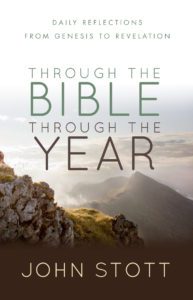
Through the Bible Through the Year by John Stott

The particular book I mentioned is Through the Bible Through the Year by John Stott.

This is a very helpful book which takes you through the whole Bible in a year. He gives you a short verse to read every day with a couple of paragraphs about it. I think it’s a brilliant resource for people new to the Bible. The late John Stott was a wonderful Bible teacher with a gift for communication.

Share this:

How to deal with hostile people | Psalm 5 Reflection

How do you deal with people who are actively hostile to you? It’s something we in the church don’t often talk about – but we need to. I learnt this from personal experience – the Psalms helped me deal with this situation in my own life.

This is part of the weekly Thought for the Week series. This series is designed to give a short, 10-minute ‘thought’, including a Bible reading and a prayer. At the moment I am working my way through the Psalms but I may take a break from them after a while and look at another part of the Bible.

Do subscribe to the mailing list if you want to get these delivered by email, or subscribe directly on YouTube if you want to see them there.

You can see the previous week’s thought on Psalm 4 “A Psalm for anxious nights” here.

Share this:

People, not stuff | Ecclesiastes 4:1-16 Sermon

A sermon on Ecclesiastes 4:1-16, part of a sermon series on Ecclesiastes preached at our church.

What makes us happy in the end? Is it more and more stuff? In this passage from Ecclesiastes, we hear about how we need to prioritise relationships over things.

There are a lot of things that can go wrong between us in the world – whether that’s something overt like oppression or even something like envy. How can we seek to get our priorities right to enjoy our lives the way God wants us to?

Read the passage online via Bible Gateway.

You can see last week’s sermon on the blog as well.

Share this:

Course Study Guides

One thing I’ve been meaning to do for a while now is create study guides for the different courses. I want the courses to be accessible to church groups, but I know that many leaders don’t have the confidence to lead on their own without a study guide. What I will be doing over the next few weeks is working my way through some of the courses to add study guides, starting with the What is Christianity? course.

I’ve already completed the study guide for the first session on Creation. I’d love any feedback you have about the format, what kind of things would be useful, etc.

If you’d like to use any of the Understand the Bible courses as part of a church group, you can do that online. See the churches subscription section for more information.

Share this:

Learn to read the Bible #2: Mark 1:9-13

I’ve just published the second part of the Learn to read the Bible series on Mark’s Gospel. This week we are looking at Mark 1:9-13, the baptism of Jesus and his temptation in the wilderness.

For those who are coming to this new, the idea behind this series is not for me to simply explain everything to you, but rather to give you things to think about yourself. This is about training you to read the Bible for yourself, rather than just giving you all the answers!

Read the passage online here (although I’d suggest it’s better to find it in a physical Bible!). You may also want to have a pen and paper handy to jot down notes and things you want to look into more.

Share this:

A Psalm for anxious nights | Psalm 4

Do you ever have nights when you can’t sleep because you’re worried or anxious? What do you do during those moments? Here David’s Psalm gives us some helpful practical advice about what to do.

This is part of the weekly Thought for the Week series. This series is designed to give a short, 10-minute ‘thought’, including a Bible reading and a prayer. At the moment I am working my way through the Psalms but I may take a break from them after a while and look at another part of the Bible.

Do subscribe to the mailing list if you want to get these delivered by email, or subscribe directly on YouTube if you want to see them there.

Share this:

How to make sense of life | Eccl 3:1-22 | Sermon

A sermon on Ecclesiastes 3:1-22. This is the sermon which inspired my post yesterday about how death teaches us the meaning of life.

How do we make sense of the world when it seems so confusing? Why do bad things happen to good people, and good things happen to bad people? How do make sense of the chaos that seems to happen to all of us?

Ecclesiastes is a book which does not dodge the big questions – in fact, it takes them square on.

Read the passage online here.

See the previous one in the series here.

Share this:

Death teaches us the meaning of life

A short reflection on how death teaches us the meaning of life, from Ecclesiastes chapter three.

The last few months have caused many of us to reflect on the deeper questions of life. The daily press briefings giving an account of the number of people who have died from covid have made us all reflect on our own mortality. Perhaps you have been thinking about these questions. Perhaps you’ve been wondering what it all means. Why do we have to die? Why is that people’s lives are cut short? Why is it that we seem to desire more from life?

What Ecclesiastes teaches about life and death

In our church’s midweek service, we have started studying a book of the Bible called Ecclesiastes. One of the things I value about Ecclesiastes is that it doesn’t shrink back from the big questions. Ecclesiastes is a book which is refreshingly honest about death. For example, consider these words from Ecclesiastes 3:19-20:

Surely the fate of human beings is like that of the animals; the same fate awaits them both: as one dies, so dies the other. All have the same breath; humans have no advantage over animals. Everything is meaningless. All go to the same place; all come from dust, and to dust all return.

The writer of Ecclesiastes, who calls himself the Teacher, says that human beings and animals share equally in death. And so, he says, we have no advantage over animals.

And he’s absolutely right, isn’t he – it is our fate regardless of what happens in life. Whether we’ve been rich or poor, a somebody or a nobody, hard working or lazy, we’re all going to end up in a box six feet under. That is the common fate of humanity: whether you die of covid, or whether you die young or old – it doesn’t matter. The word the Teacher uses is “meaningless”.

When we really consider death and all that it means, it makes us feel uncomfortable. It seems so unfair, so arbitrary, so meaningless. How can human life be so wonderful and at the same time so short? We never seem to get all that we want out of life!

Looking for the deeper truth

This is where it’s important to listen further to Ecclesiastes. The Teacher isn’t trying to make us depressed in thinking about death – he is trying to teach us a deeper truth. That is, death should actually teach us the meaning of life. Earlier on in Eccl 3, the Teacher says God “set eternity in the human heart”. All human beings have an understanding of eternity. We yearn for that which is beyond our current experience.

On June 8th 1941, C.S. Lewis preached a sermon called The Weight of Glory, in my opinion one of his most insightful pieces. He talks about the fact that we all have a desire for “something that has never actually appeared in our experience”. We sometimes catch a glimpse of it in a book, or music, or a good meal, or friends or family, but they never seem to satisfy in the way that they should. He says:

These things—the beauty, the memory of our own past—are good images of what we really desire; but if they are mistaken for the thing itself they turn into dumb idols, breaking the hearts of their worshippers. For they are not the thing itself; they are only the scent of a flower we have not found, the echo of a tune we have not heard, news from a country we have never yet visited.

He goes on to say that the desire that we have is actually a desire for the greater, eternal things that mankind was created for – for God and his glory.

Where to find true happiness

This is the point that C.S. Lewis, and Ecclesiastes, are making: if we see this life as everything there is, and all our happiness is to be found here, we will never be happy. Death should teach us that the things of this life are not ultimate. The pleasures of this life are fleeting and temporary. Rather than seeking them as an end in themselves, we should look instead to the giver of these gifts, the God who gives meaning to our lives.

It is only in him and through him that our lives begin to find meaning. He is the Alpha and the Omega, the beginning and the end. When we seek him, and submit our lives to him, our lives start to take on the meaning we are seeking. And we can trust that the one who defeated death and brought life and immortality to light through the gospel will raise us up to eternal life.

So let us pray, as Moses did in the words of Psalm 90:

Teach us to number our days,
    that we may gain a heart of wisdom.

This was a short Thought for the Week I wrote and recorded for our local ‘Talking Times’, an audio newspaper for those who are visually impaired.

Want more? You can see all posts on Ecclesiastes here.

Share this: