What makes a good person? – Psalm 14

Do you think of yourself as a good person? Why do you think that? Psalm 14 helps us to understand what makes a good person – and it may surprise you.

The other video I mention is available here on the website, part of the “What is sin?” course.

This is part of the weekly Thought for the Week series. This series is designed to give a short, 10-15 minute ‘thought’, including a Bible reading and a prayer. At the moment I am working my way through the Psalms but I may take a break from them after a while and look at another part of the Bible.

Do subscribe to the mailing list if you want to get these delivered by email, or subscribe directly on YouTube if you want to see them there.

You can see the previous week’s thought on Psalm 13 “When trouble seems to go on forever” here.

Share this:

From darkness to light – Isaiah 60 Sermon

It seems like we are living in dark days at the moment. 2020 has been a very strange year for everyone. But there have been dark times before. The people of Israel in the Old Testament experienced lots of dark times – yet Isaiah here prophecied of how that darkness would turn to light.

This sermon looks at the darkness, the light, and how God was going to bring them from one to the other. The good news is, it’s something which is for us as well!

Read the passage online via Bible Gateway.

Enjoyed this sermon? See more on the sermons page.

Share this:

How does God guide us? – Your questions answered

Guidance is something we’re all looking for. What career should I choose? Who should I marry? Whenever we’re facing big decisions (or even small decisions!) we want to know what the right choice is. As Christians, we believe that God guides us. But how?

Here’s a brief video which introduces the big picture of how God guides us today.

How God guides us: key points

  • We need to look at the big picture of what God wants us to do with our lives.
  • The big picture is found in the two greatest commandments (love God and love our neighbour) – Mark 12:29-31.
  • How do we know what that actually looks like?
  • We love God by asking him to help us – Psalm 25:4-5. God loves us when we ask him for his help and guidance.
  • The 10 Commandments are a guide to how we love others – they’re God’s framework for helping us know how to love.
  • The rest of the Bible helps us to understand what God’s will is for us.
  • You could sum it up in Proverbs 3:5-6.
Trust in the Lord with all your heart
   and lean not on your own understanding;
in all your ways submit to him,
   and he will make your paths straight.

Explore further

Proverbs is great for guidance. You might be interested in the Wisdom of Proverbs: Guidance.

You might also appreciate this sermon on guidance from Proverbs 16.

Also check out session #9 of the Heidelberg Catechism, God our Father.

Your questions answered

This is the fourth video for the Your questions answered feature. See the rest of the series on that page.

If you have a question about Christianity or the Bible, please send them in or comment below.

Share this:

Mark 3:7-12 – Learn to read the Bible #11

I’ve just published the eleventh part of the Learn to read the Bible series on Mark’s Gospel. This week we are looking at Mark 3:7-12, when Jesus is surrounded by crowds.

For those who are coming to this new, the idea behind this series is not for me to simply explain everything to you, but rather to give you things to think about yourself. This is about training you to read the Bible for yourself, rather than just giving you all the answers!

See this page if you’d like a few pointers for how to use these videos. Don’t forget to pray!

You can read the passage online here (although I’d suggest it’s better in a physical Bible). You may also want to have a pen and paper handy to jot down notes and things you want to look into more.

Key points from Mark 3:7-12

  • Jesus withdrew to the lake but the crowds followed him. Why do you think Jesus tried to withdrawn from the crowd?
  • People came to him from a very long way away – it seems like his fame was spreading. Imagine what it would be like today if someone appeared who could actually heal people!
  • He kept a boat ready to stop people from crowding him. What do you think this says about Jesus’ priorities? Does this mean that Jesus thought it was more important to teach people than to heal them? Why do you think that is?
  • The impure spirits knew who Jesus was – but Jesus forbade them from telling people about him. Why? Do you think that people might have got the wrong idea about Jesus? – maybe people would have thought that Jesus was there just to heal them or do things they wanted.
  • How do you see Jesus? Do you see him as someone to submit to and listen to, or as someone who is simply there to heal us and do occasional miracles?

Looking for more?

You can see the rest of the videos in this series on the this page. If you’d like a more focussed series teaching the Christian faith, check out the teaching programme.

You might also want to see the previous episode in the series on Mark 3:1-6.

Share this:

When trouble seems to go on forever – Psalm 13

Have you ever been in a situation where trouble seemed never-ending? This is exactly the situation David was in when he wrote this Psalm. This Psalm teaches us how to deal with these times.

This is part of the weekly Thought for the Week series. This series is designed to give a short, 10-15 minute ‘thought’, including a Bible reading and a prayer. At the moment I am working my way through the Psalms but I may take a break from them after a while and look at another part of the Bible.

Do subscribe to the mailing list if you want to get these delivered by email, or subscribe directly on YouTube if you want to see them there.

You can see the previous week’s thought on Psalm 12 “When truth is political” here.

Share this:

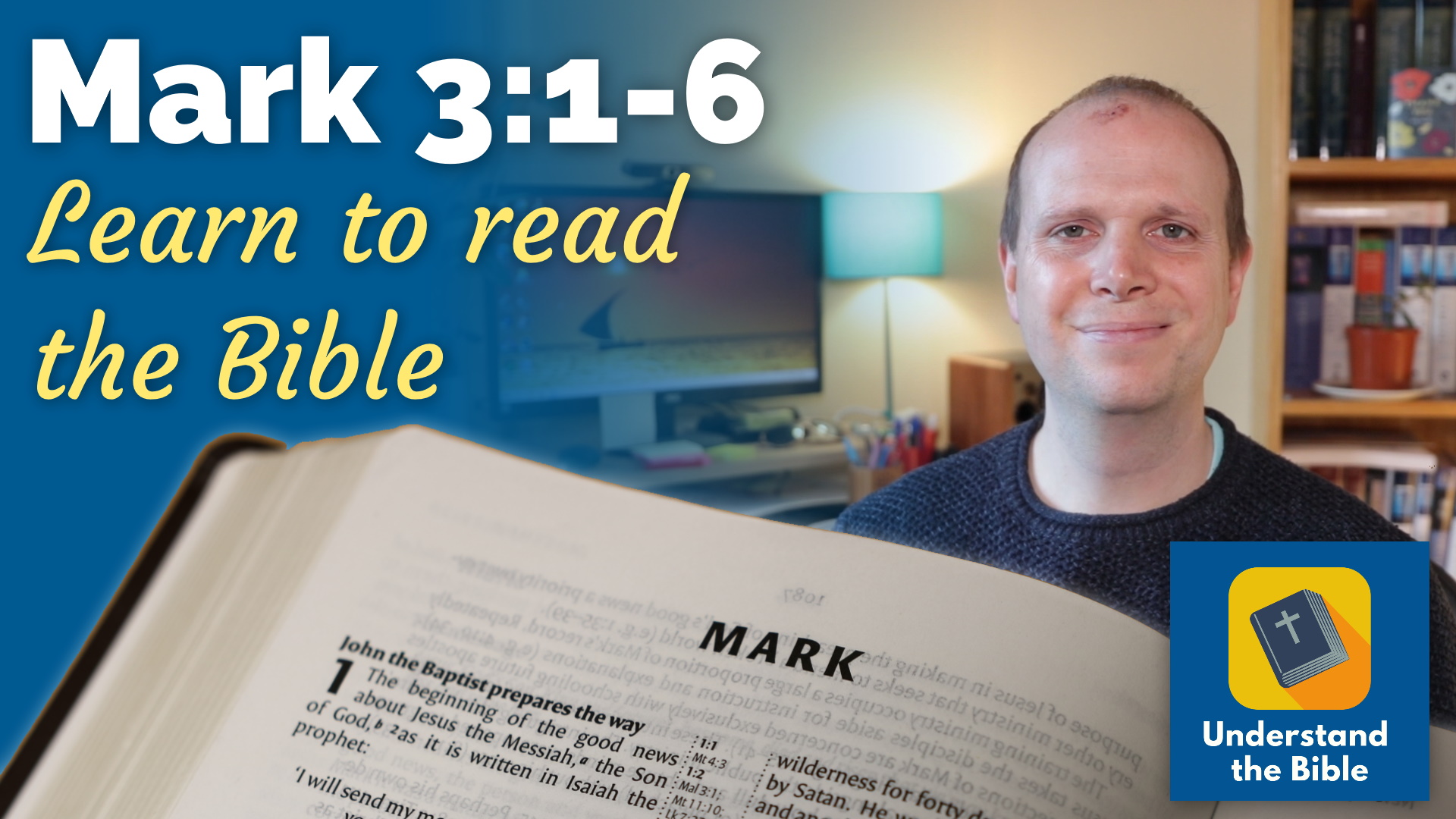
Mark 3:1-6 – Learn to read the Bible #10

I’ve just published the tenth part of the Learn to read the Bible series on Mark’s Gospel. This week we are looking at Mark 3:1-6, when Jesus heals a man on the Sabbath.

For those who are coming to this new, the idea behind this series is not for me to simply explain everything to you, but rather to give you things to think about yourself. This is about training you to read the Bible for yourself, rather than just giving you all the answers!

See this page if you’d like a few pointers for how to use these videos. Don’t forget to pray!

You can read the passage online here (although I’d suggest it’s better in a physical Bible). You may also want to have a pen and paper handy to jot down notes and things you want to look into more.

Key points from Mark 3:1-6

  • It begins “Another time” – could Mark be suggesting this is related to the previous passage? They both seem to be about the Sabbath and Law.
  • “Some of them” (the Pharisees? – makes sense if it follows on from the previous passage) were looking for a reason to accuse Jesus. Why do you think they would do this? Do you think some of your friends or family accuse Jesus without giving him a fair hearing?
  • Jesus asked the man to stand in front of everyone – he didn’t heal the man in secret, but did it in public. Almost as if he was looking to confront the Pharisees.
  • Jesus asked “What is Lawful on the Sabbath – to do good or to do evil”. I think this is a really good principle when thinking about God’s laws: as we saw last time, it’s easy to think the Law is a bad thing, or for obeying the Law to become an end in itself. Maybe you could spend some time thinking about the way you think about the law and how we often get this principle wrong.
  • This doesn’t mean we can ignore God’s laws! – but it’s easy to see them in the wrong way.
  • The Pharisees and Herodians end up plotting to kill Jesus – what irony! Killing someone is unlawful, whereas healing on the Sabbath is not. Why do you think they reacted like this? What does this say about our own sinfulness?

Looking for more?

You can see the rest of the videos in this series on the this page. If you’d like a more focussed series teaching the Christian faith, check out the teaching programme.

You might also want to see the previous episode in the series on Mark 2:23-28.

Share this:

When truth is political – Psalm 12

In 2016, the Oxford Dictionary chose “post-truth” as the word of the year. We are living in days when truth itself has become political. How should we respond?

This is part of the weekly Thought for the Week series. This series is designed to give a short, 10-15 minute ‘thought’, including a Bible reading and a prayer. At the moment I am working my way through the Psalms but I may take a break from them after a while and look at another part of the Bible.

Do subscribe to the mailing list if you want to get these delivered by email, or subscribe directly on YouTube if you want to see them there.

You can see the previous week’s thought on Psalm 11 “Will good triumph over evil” here.

Share this:

Mark 2:23-28 – Learn to read the Bible #9

I’ve just published the ninth part of the Learn to read the Bible series on Mark’s Gospel. This week we are looking at Mark 2:23-28, when Jesus is questioned about the Sabbath.

For those who are coming to this new, the idea behind this series is not for me to simply explain everything to you, but rather to give you things to think about yourself. This is about training you to read the Bible for yourself, rather than just giving you all the answers!

See this page if you’d like a few pointers for how to use these videos. Don’t forget to pray!

You can read the passage online here (although I’d suggest it’s better in a physical Bible). You may also want to have a pen and paper handy to jot down notes and things you want to look into more.

Key points from Mark 2:23-28

  • When you read a passage, think about the things which are repeated – it can often be a really helpful clue in getting to the main point.
  • In this passage, “lawful” is repeated a couple of times, and the Pharisees mention one of the Ten Commandments.
  • There are three things to think about:
    1. Eating corn on the Sabbath was not prohibited by the Ten Commandments. Why do you think the Pharisees added this law? Are there any ways we add to God’s laws?
    2. Jesus said that the laws were made for us – God’s laws are for our good. Do you think of the law like that? Do you think of obeying God as a joyful thing?
    3. Jesus said the Son of Man (himself) is lord even of the Sabbath. We are accountable to him at the end of the day. Are we seeking to obey him in everything?

Looking for more?

You can see the rest of the videos in this series on the this page. If you’d like a more focussed series teaching the Christian faith, check out the teaching programme.

You might also want to see the previous episode in the series on Mark 2:18-22.

Share this:

Will good triumph over evil? Psalm 11

We human beings seem conditioned to believe that good will win out over evil. But how can we have grounds for this confidence?

This is part of the weekly Thought for the Week series. This series is designed to give a short, 10-minute ‘thought’, including a Bible reading and a prayer.At the moment I am working my way through the Psalms but I may take a break from them after a while and look at another part of the Bible.

Do subscribe to the mailing list if you want to get these delivered by email, or subscribe directly on YouTube if you want to see them there.

You can see the previous week’s thought on Psalm 10 “How to deal with injustice” here.

Share this:

Mark 2:18-22 – Learn to read the Bible #8

I’ve just published the eighth part of the Learn to read the Bible series on Mark’s Gospel. This week we are looking at Mark 2:18-22, when Jesus is questioned about fasting.

For those who are coming to this new, the idea behind this series is not for me to simply explain everything to you, but rather to give you things to think about yourself. This is about training you to read the Bible for yourself, rather than just giving you all the answers!

See this page if you’d like a few pointers for how to use these videos. Don’t forget to pray!

You can read the passage online here (although I’d suggest it’s better in a physical Bible). You may also want to have a pen and paper handy to jot down notes and things you want to look into more.

Key points from Mark 2:18-22

  • The Pharisees and John the Baptist’s followers were fasting. Fasting is not something which is generally associated with happiness! Spend a few moments thinking about why they were fasting.
  • Jesus replies to them and says they can’t fast while the bridegroom is with them – does that mean he is the bridegroom? Is he hinting at what is going to happen to him when he talks about the bridegroom being taken away?
  • If Jesus’ followers can’t fast while he is with them because it is a time of rejoicing and joy – what does that mean about our lives? If Jesus is with us, how should that make a difference to our own emotional state?
  • Jesus finishes by talking about the contrast between the new and the old. Now that he is here, we have to do things differently. Think about how you’ve changed since becoming a Christian. Think about the ways in which you need to do things differently with Jesus.

Looking for more?

You can see the rest of the videos in this series on the this page. If you’d like a more focussed series teaching the Christian faith, check out the teaching programme.

You might also want to see the previous episode in the series on Mark 2:13-17.

Share this: