News

God is… infinitely good

In this eighth part of the Get to know God series, we are thinking about how God is good. Not just good – God is infinitely good. He is the very definition of goodness itself. But what does it mean for God to be good? What does that look like? And what does it mean for us in our lives and how we relate to him? Let’s start, as always, by looking at the Bible before we turn to think about what it means for us.

What does the Bible say about God’s goodness?

Only God is good

A man once came to Jesus to ask him a question. The man called him “Good teacher”, but Jesus responded: “Why do you call me good? No one is good – except God alone” (Mark 10:18). Jesus didn’t respond like this because Jesus was saying he wasn’t good (we’ll come onto that in the final session!). But he wanted the man to think about what he was saying. Who is truly good? Only God is truly good.

If we want to see and know what true goodness is, we need to look to the Lord. He alone has true goodness. He is 100%, pure good. And, at the risk of stating the obvious, it’s worth making the point that the opposite of good is evil. That which is not good is evil.

You might be thinking – if God alone is good, what does that say for human beings? Are human beings not good? Or, at least, can human beings not be good? We’ll come onto that question in a minute!

Continue reading “God is… infinitely good”
Share this:

Mark 2:23-28 – Learn to read the Bible #9

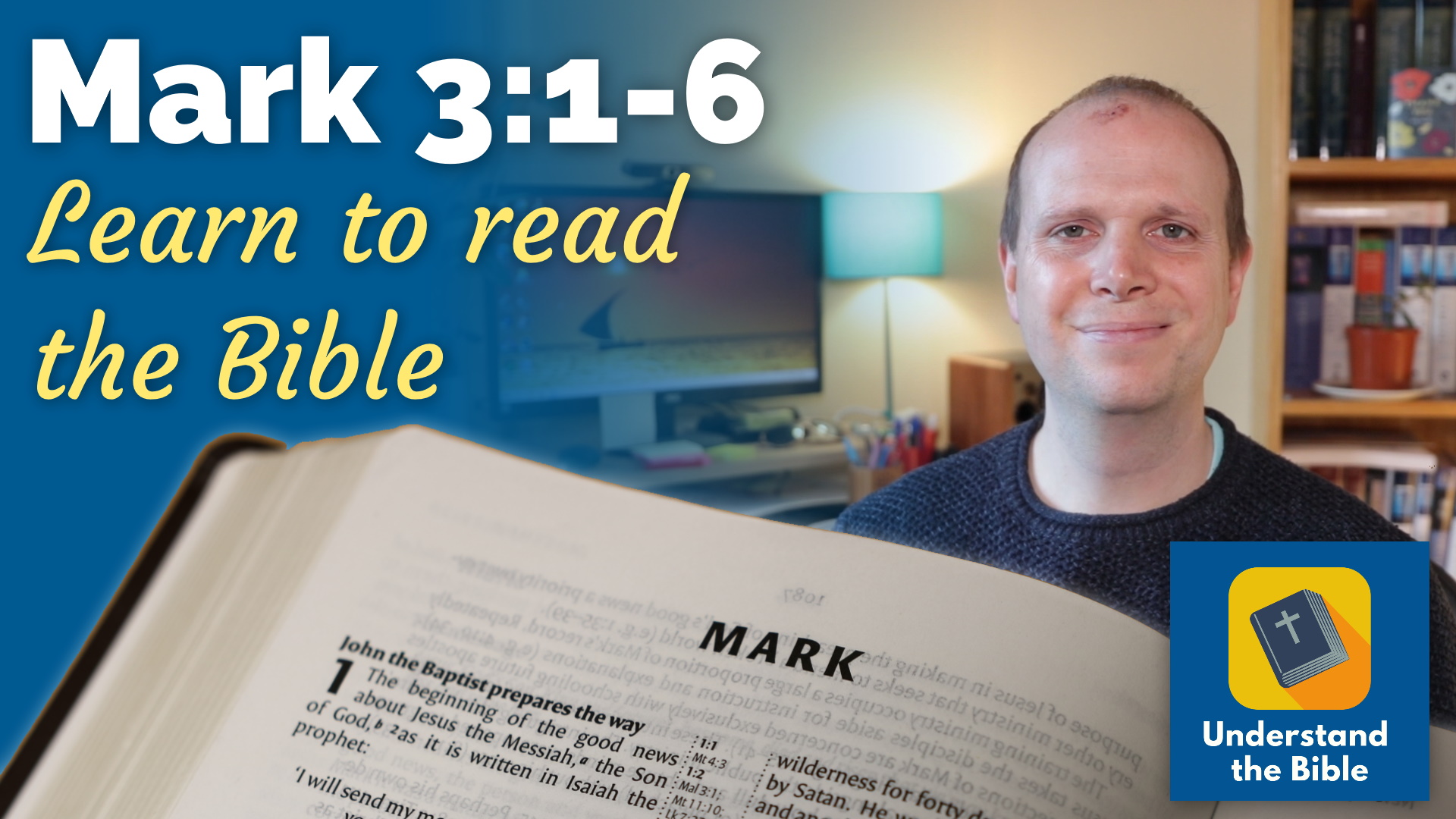
I’ve just published the ninth part of the Learn to read the Bible series on Mark’s Gospel. This week we are looking at Mark 2:23-28, when Jesus is questioned about the Sabbath.

For those who are coming to this new, the idea behind this series is not for me to simply explain everything to you, but rather to give you things to think about yourself. This is about training you to read the Bible for yourself, rather than just giving you all the answers!

See this page if you’d like a few pointers for how to use these videos. Don’t forget to pray!

You can read the passage online here (although I’d suggest it’s better in a physical Bible). You may also want to have a pen and paper handy to jot down notes and things you want to look into more.

Key points from Mark 2:23-28

  • When you read a passage, think about the things which are repeated – it can often be a really helpful clue in getting to the main point.
  • In this passage, “lawful” is repeated a couple of times, and the Pharisees mention one of the Ten Commandments.
  • There are three things to think about:
    1. Eating corn on the Sabbath was not prohibited by the Ten Commandments. Why do you think the Pharisees added this law? Are there any ways we add to God’s laws?
    2. Jesus said that the laws were made for us – God’s laws are for our good. Do you think of the law like that? Do you think of obeying God as a joyful thing?
    3. Jesus said the Son of Man (himself) is lord even of the Sabbath. We are accountable to him at the end of the day. Are we seeking to obey him in everything?

Looking for more?

You can see the rest of the videos in this series on the this page. If you’d like a more focussed series teaching the Christian faith, check out the teaching programme.

You might also want to see the previous episode in the series on Mark 2:18-22.

Share this:

Will good triumph over evil? Psalm 11

We human beings seem conditioned to believe that good will win out over evil. But how can we have grounds for this confidence?

This is part of the weekly Thought for the Week series. This series is designed to give a short, 10-minute ‘thought’, including a Bible reading and a prayer.At the moment I am working my way through the Psalms but I may take a break from them after a while and look at another part of the Bible.

Do subscribe to the mailing list if you want to get these delivered by email, or subscribe directly on YouTube if you want to see them there.

You can see the previous week’s thought on Psalm 10 “How to deal with injustice” here.

Share this:

God is… infinitely wise

In the seventh part of the Get to know God series, we’re looking at how God is infinite in wisdom. We’ll think a little bit about what wisdom is, how it relates to God, and what we need to do. As usual for this series, firstly we’ll look at what the Bible says, and then we’ll think through some practical points for us.

What does the Bible say about God’s wisdom?

Wisdom belongs to God

Where then does wisdom come from?
   Where does understanding dwell?
It is hidden from the eyes of every living thing,
   concealed even from the birds in the sky.
Destruction and Death say,
  ‘Only a rumour of it has reached our ears.’
God understands the way to it
   and he alone knows where it dwells
Job 28:20-23

Wisdom is something that God alone possesses. This is echoed in the New Testament in Romans 16:27 where Paul says, “to the only wise God”. Wisdom is something that God simply has perfectly and infinitely, it is part of who he is.

In the Bible, wisdom is about making good and right decisions. (If you’re interested, I have a post about Wisdom and Guidance in Proverbs). It’s about doing what is good and avoiding what is evil. We human beings have limited wisdom – and we’ll come onto that later. But this is not the case with God.

God doesn’t have to listen to advisers to tell him what the right course of action is. God simply knows, because he is perfect wisdom. We human beings are capable of making poor decisions for all sorts of reasons. Maybe we make decisions based on misunderstanding or incomplete knowledge. But God never has that problem: all of his decisions are perfect. God never has to worry about which way to go – he always knows.

Continue reading “God is… infinitely wise”
Share this:

How to find joy – Ecclesiastes 11:7-12:7 Sermon

A sermon on Ecclesiastes 11:7-12:8, part of a sermon series on Ecclesiastes preached at our church. As you can probably tell, this sermon was actually recorded at home due to the present lockdown restrictions in the UK!

People sometimes think Christians are “anti-joy”. That couldn’t be further from the truth: God wants us to find joy. In fact, it’s wrong not to find joy as Christians. But the joy that God wants us to have is more than the joy the world can give. How do we find joy beyond the things of this lifetime?

Read the passage online via Bible Gateway.

You can see the previous sermon on Ecclesiastes 11:1-6 here. All content from Understand the Bible about Ecclesiastes can be found under the Ecclesiastes tag. All sermons can be found in the sermons category.

Share this:

God is… infinitely powerful (omnipotent)

The sixth part of our Get to know God series looks at God’s omnipotence – the fact that he is infinitely powerful. I don’t know about you, but I’ve found the last couple of sessions have dealt with some pretty tough concepts. This week is, I hope, slightly less tough in that respect. But that doesn’t mean there isn’t plenty here to get your head around – and plenty to be encouraged by. Let’s look into it. We’ll start out by drawing out a few points from the Bible, and then we’ll think about what it means for us.

What does the Bible say?

No-one is powerful like God

No one is like you, Lord; you are great, and your name is mighty in power.

Jeremiah 10:6

The Bible often describes God’s power as being incomparable. Nothing else in all creation could come anywhere close to matching his power. His power is often seen in the things that he does.

Continue reading “God is… infinitely powerful (omnipotent)”
Share this:

Review: Redeeming Time App

Last week I heard of a new app called Redeeming Time. It’s a very simple premise: many of us, when we have a few minutes spare, will spend that time on social media. Over the course of a week it all adds up. And, if we’re honest with ourselves, it’s probably not a good use of the time.

As the app blurb says:

Fed up of wasting time on social media?
What would it look like to “waste time” with God instead?

The App gives you a way of redeeming the time that you might otherwise waste on social media. It’s really very simple.

How it works

It’s very simple and straightforward:

  1. The app asks you how much time you have. If, for example, you’re waiting for a train, you could put it the number of minutes you have til you have to go.
  2. The app will show you which Bible books you can read in the time you have available (obviously it’s approximate, depending on you having an average reading speed!)
  3. You select one, and the app will show you the book you’ve selected.
  4. One nice touch – when you’ve completed it, you’ll be shown a few questions to help you think about it.

If you want to read a longer book of the Bible, the app will also keep tabs on how far through the book you’ve got, so you can come back to it later.

See the screenshots below.

Who will benefit from it

If you’re someone who is tempted to spend too much time on social media (and I know the pull of that temptation!) this app could prove to be really helpful. Although I’ve uninstalled the Facebook and Twitter apps on my phone (as I explain in this video), it’s still tempting. Especially if you’re waiting around in a queue or something.

I think the people who will benefit from this the most are people who regularly find themselves waiting around, e.g. for public transport. I think this would be a great way of deciding, for example, that you wanted to read through the Bible in the time you’d normally spend on Facebook.

A few reservations

Having said all this, I have one or two reservations about the app.

It doesn’t add much to other apps

I can’t really see how this adds a huge amount to other apps. You can already get the Bible on apps – I have a couple on my phone. The only real thing it adds is the time calculation. My Bible app remembers where I got up to in my Bible reading – whenever I open it, it opens to the last place I got to. I could easily read through a book of the Bible using a Bible app rather than using the Redeeming Time app.

One feature which would make the Redeeming Time app useful is a Bible reading plan: rather than simply ordering the books of the Bible by how long it would take to read them, put them in order. If the app kept track of where you’d got up to, that could be useful. Of course, there are already apps which are designed to give you a certain amount of the Bible to read, such as the Daily Readings Spurgeon app which I wrote about a while back. But the ones I know of are based on giving you a reading every day – it might be helpful to have one which let you go at your own pace.

I’m not sure it will help people addicted to social media

One of the problems with addiction to social media is that it’s very tempting to use social media at all sorts of inappropriate times. I sometimes find myself scrolling through Facebook while watching TV, which is really not a good idea! You can’t concentrate on two things at once.

One of the things about reading the Bible is that it’s not like social media. You can’t just glance through the Bible – it takes thought and concentration. I’m not convinced that reading through part of the Bible in the same time you would usually scroll through Facebook is going to be a hugely beneficial spiritual exercise. I would suggest looking at some of the alternatives below.

Other ways to redeem the time

Be very careful, then, how you live – not as unwise but as wise, making the most of every opportunity, because the days are evil.

Ephesians 5:15-16

It’s really important to redeem our time and to use it well. We need to make the most of every opportunity – if we have a few spare minutes on a railway platform, we should use it! Personally I am not convinced that the Redeeming Time app is the best way for me. But there are many other ways of redeeming the time.

Listen to a podcast / watch a YouTube video

Podcasts have been around for a long while, but I’ve only really started to get into them recently. If you want to grow as a Christian, listening to a Christian podcast might be just the thing you need. There are lots available, for example Cooper & Cary have words, or Ask Pastor John. You can get sermons, theology, anything you like. You can find plenty of good content on YouTube too. (I should say that Understand the Bible has its own YouTube channel and podcast!)

Is a podcast better than reading the Bible directly? Well obviously I wouldn’t recommend listening to a podcast instead of reading the Bible in general! But I think a podcast / YouTube video could be more suitable to the level of attention you can give when you’re waiting for a train. Personally I think we should not just be reading the Bible but also things which help us to understand the Bible, to put pieces together.

Do a course

One of the reasons I started Understand the Bible was to give people a way of ‘redeeming the time’. If you typically have about 15 minutes per day free, then you could do one of the Understand the Bible courses. (You can even get the app – there are links at the bottom of every page). There are other courses available, such as The Whole Christ which the Christian Institute have made freely available.

You will probably find that doing something to complement reading the Bible might actually help your Bible reading. My suggestion is to do both – read the Bible, but also do things which will help you to understand what you’re reading better.

Pray

This is probably the most fundamental one! One of the best ways of redeeming the time is to pray. You can pray anywhere, and you don’t have to have a set amount of time to do it. Just talk to God about what’s on your mind and heart. Bring the people you care about, as well as your problems and concerns to him.

I know it sounds a bit silly to admit it, but one of the most helpful things for me spiritually was realising that I didn’t have to pray at a set time every day. A few years ago I started praying when I walked places, praying when I was in the shower, praying whatever I was doing. It’s been very helpful for me spiritually! Prayer should be like breathing to a Christian. Most of us, if not all of us, don’t pray anything like as much as we should.

Of everything that we could do to redeem the time, perhaps the best thing would be to simply put the phone down and pray. Just a thought.

Share this:

Raised to new life (Heidelberg 17)

In this session we look at the best news ever – the resurrection of Jesus Christ from the dead. Why is it the best news? Let’s look into it!

There is only one question in this session: “How does Christ’s resurrection benefit us?” But there are three parts to the answer:

  • First, by his resurrection he has overcome death, so that he could make us share in the righteousness which he had obtained for us by his death.
  • Second, by his power we too are raised up to a new life.
  • Third, Christ’s resurrection is to us a sure pledge of our glorious resurrection.

The key thing is that the resurrection is not simply a future event, but something that makes a difference for our lives in the here and now.

If you enjoy this, you can do the whole series right here on the website, or on the app (see links on the right hand side of the page). Alternatively, I am uploading them regularly to YouTube and Facebook. All sessions on YouTube are available on this playlist.

Share this:

God is… impassible (without passions)

In this fifth part of the Get to know God series, we’re looking at something called God’s impassibility. This is a really important aspect of God, and yet out of all of them this is probably the least popular. Part of the problem is that people don’t understand what ‘passions’ means! But this is important for understanding who God is: do we want a God who is actually able to help us in our suffering? For that, we need a God who is impassible.

What does impassible even mean?

A few years ago, a friend of mine wrote an article defending God’s impassibility. He started out with a brief definition of impassibility:

Divine impassibility refers to the belief that God can neither be acted on from without, nor experience ‘emotional’ change within, and that, more specifically, God can thus neither be caused to suffer, nor choose to suffer, in his divine nature.

This is a good definition to be going on with. Impassibility, or being ‘without passions’, means that God doesn’t have emotions in the same way that we do. (This is especially true about suffering – God does not suffer). Emotions, as it says, are about change: we human beings generally can’t go through a day without experiencing a number of emotional changes. An emotion is a change. But – as we have already thought about – God does not change. God is constant. That’s good news for us!

It’s good news because it means that God is not changeable like us, but is above our ways. Let’s take a look at the Bible to see what it says.

Continue reading “God is… impassible (without passions)”
Share this:

Mark 2:18-22 – Learn to read the Bible #8

I’ve just published the eighth part of the Learn to read the Bible series on Mark’s Gospel. This week we are looking at Mark 2:18-22, when Jesus is questioned about fasting.

For those who are coming to this new, the idea behind this series is not for me to simply explain everything to you, but rather to give you things to think about yourself. This is about training you to read the Bible for yourself, rather than just giving you all the answers!

See this page if you’d like a few pointers for how to use these videos. Don’t forget to pray!

You can read the passage online here (although I’d suggest it’s better in a physical Bible). You may also want to have a pen and paper handy to jot down notes and things you want to look into more.

Key points from Mark 2:18-22

  • The Pharisees and John the Baptist’s followers were fasting. Fasting is not something which is generally associated with happiness! Spend a few moments thinking about why they were fasting.
  • Jesus replies to them and says they can’t fast while the bridegroom is with them – does that mean he is the bridegroom? Is he hinting at what is going to happen to him when he talks about the bridegroom being taken away?
  • If Jesus’ followers can’t fast while he is with them because it is a time of rejoicing and joy – what does that mean about our lives? If Jesus is with us, how should that make a difference to our own emotional state?
  • Jesus finishes by talking about the contrast between the new and the old. Now that he is here, we have to do things differently. Think about how you’ve changed since becoming a Christian. Think about the ways in which you need to do things differently with Jesus.

Looking for more?

You can see the rest of the videos in this series on the this page. If you’d like a more focussed series teaching the Christian faith, check out the teaching programme.

You might also want to see the previous episode in the series on Mark 2:13-17.

Share this: